

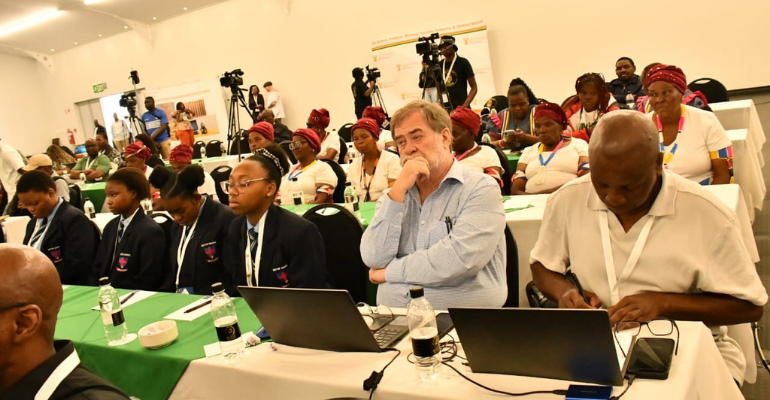
Presidential Report, Oral History Association of South Africa (OHASA) Annual General Meeting, The Ranch Resort, Polokwane, 9 October 2025
Deputy President of OHASA
Members of the Executive Committee
Chairpersons of Oral History Provincial Chapters
Representatives of The National Department of Sport, Arts and Culture
Members of the Limpopo Local Organising Committee of OHASA 2025
Limpopo Provincial Archives and Records Service
Members of the OHASA sub committees
Members of OHASA
Esteemed Guests
We are delighted that you are here.
It is with deep humility and massive pride that I stand before you today as the President of the Oral
History Association of South Africa. I am honoured to assume the responsibilities entrusted to me,
and I do so with a profound sense of purpose and commitment. Indeed, our journey as OHASA has not been
without its challenges. We have weathered many storms, but our collective resolve has always succeeded.
As the African proverb reminds us, “When the roots are deep, there is no reason to fear the wind.” What
then should we fear? If we allow fear to take root, what future will we offer the next generation? We
stand tall today because of the deep foundations laid by our predecessors. Their courage and vision
continue to guide us. We must remain committed to our mission to preserve oral history and heritage,
resisting any forces that seek to erode the pride, dignity, and the dreams of our people.
Colleagues, today marks one year since this Executive Committee assumed office in October 2024. We do not bring tales of miracles, but we do bring tangible, deliverable achievements that are visible and impactful. We invite you to engage with this report, to scrutinise it, and to offer constructive feedback for the benefit of our members and the broader South African community. OHASA is a democratic organisation, rooted in justice and inclusivity. We are an association for all—young and old, scholars and village professors, across racial lines and borders, both within and beyond Africa.
We have set goals for ourselves, and therefore, we conducted strategic planning 12 & 13 February 2025 held at the Provincial Archives here in in Polokwane, to ensure coherent coordination across all departments of OHASA. We need to serve and safeguard Oral History Heritage in all nine provinces and to ensure that we foster national, regional, and international partnerships with relevant bodies. Our aim is to establish OHASA as a professional association that operates in accordance with the principles of integrity and high ethical standards. We have been very attentive to what the Honourable Deputy Minister of Sport, Art, and Culture, Ms. Peace Mabe, said in her keynote address at the KZN OHASA conference in Ulundi in October 2024, namely that oral history should be promoted nationally. We are thus doing our part in ensuring that the DM’s wishes become a reality. We do hope that financial resources will be made available to ensure the viability of those structures. We have the long-standing Provincial Chapter, Oral History Association of Mpumalanga (OHAMP). They took the initiative, and it has evolved to be the precursor for all other structures. We are proud of them, and our doors are open to provide further support for their efforts. We have worked together more closely during the Oral History Provincial Conferences, where OHASA pledged its support by forwarding messages of support.
The Deputy President’s portfolio has supported and encouraged the establishment of the oral history chapters in the different provinces. Members of OHASA, we are proud to announce that Gauteng Province has launched its Gauteng Oral History Chapter (GOHC). The OHASA President and Deputy-President were invited to be part of the induction and also to provide guidelines for the Chapter. The work done by the chapter is commendable, they have managed to formulate branches in all the districts of Gauteng. They have showed character and leadership by popularising OHASA to all interested individuals in Gauteng. As we speak there were at least 12 papers successfully accepted for this conference coming from the Gauteng Provincial Chapter. Above that, they have ensured that a substantive number of their members are with us this week.
Our work as the new Executive Committee, through the Deputy President, can be traced back to the establishment of the Oral History Association of KwaZulu-Natal (OHA-ZN) by the KZN Archives & Records Service. The chapter was officially launched on Friday, 22 August 2025 in partnership with Zulu Mpophomeni Tourism in Howick. Prior to this official launch, on the 25th of April, at the same location, I, the OHASA President, the Deputy President and Ms Khanyi Ngcobo from the National Archives were invited to the Archives Awareness Week event hosted by the KZN Archives to deliver speeches and offer messages of support for the initiative to launch the provincial chapter.
We have chapters that have followed suit with Mpumalanga, like the Eastern Cape Oral History Association (ECOHA). This chapter has survived for a few years, and it continues to do good work in promoting oral history in the Eastern Cape province.
An update on Chapters other provinces:
1. The North West has started to arrangements to have a formal structure. They have been busy with different projects
ensuring the collection of oral histories in the province. It is against this background thatOHASA was invited to give
a message of supportat an Oral History colloquiumheld in the Moses Kotane District Municipality on 25-26 September 2025.
2. The Free State marked another opportunity for OHASA to induct and persuade the province to consider this significant initiative
that could make their work doable when they decide to conduct oral history projects. This is not a decorative or glittery
structure, but rather a crucial part of the work that needs to be done for communities.
3. Northern Cape Provincial Structure: Members of OHASA, we appreciate the effort made by the Northern Cape in establishing a
structure that will eventually serve as the Chapter. The Deputy President of OHASA was invited to a meeting of the Northern
Cape Oral History Forum in Kimberley, to which he connected virtually. It was in that meeting that the structure was addressed
in terms of guidelines and expectations.
4. Limpopo Oral History Chapter: The formation of the oral history chapter in Limpopo remains a huge challenge. While a structure
had been established previously under Dr Lucky Vuma as its Chairperson, they encountered some challenges that slightly disturbed
healthy operations. Hopefully, by hosting this conference, the 22nd OHASA Conference, will galvanise the forces on the ground and
enlighten them on the significance of such a structure.
5. Western Cape: There are a number of inroads that demand the attention of OHASA, and some of the responsibilities are to engage
all the provinces to consider the establishment of an Oral History Structure; one of those provinces is the Western Cape.
6. We have hit the ground running; within no time, we were able to reach a milestone by starting plans to collaborate with the
National Heritage Council. We have had meetings with executives aimed at forging partnerships on various projects, and such
communication is still ongoing. Our primary goal is to establish an Oral History structure in each of the nine provinces of the
Republic of South Africa before the end of our term in 2027.
One will ask about the benefits of Chapters from OHASA. The high expectations might be in line with the budget, since every structure requires financial injection to survive. Currently, we are encouraging all the structures to operate in collaboration with their respective Provincial Archives. The strategy stems from the Oral History operational plans of the Provincial Archives, which shall include the Chapters’ operations for its implementation. We are not dismissing the fact that we need to be fully involved professionally and financially; we are hard at work to ensure that we secure sponsorship, allowing OHASA to commission oral history projects led by chapters. Once such a dream is realised, we will be able to contribute to the chapters and also participate in short-term opportunities for various communities in different provinces.
Colleagues allow me to allude to the establishment of the Ethics Committee after the adoption of the proposal to establish such a committee at the 2024 conference. This committee is led by the Deputy President. It has been able to draft at least three codes of conduct, one for the executive, members, and guidelines for conducting oral history, including dos and don’ts.
As Margaret Fuller once said, “If you have knowledge, let others light their candles in it.” We believe in sharing knowledge; knowledge is not meant to be hidden, but rather to be shared. When we teach, help, or explain something to someone, we don’t lose our light — we help more lights to shine. One of OHASA’s objectives is to build capacity by conducting training and workshops. We have trained 10 students to present at the National Oral History Conference. Since we started the programme, 213 learners have been trained on oral history. We are in the process of producing Training Manualss that will standardise the training programme for learners. Training is the primary method for imparting knowledge, and it also serves as a vehicle to promote the OHASA activities. People get to know the organisation through its activities. We are present on most social media platforms, including TikTok. The marketing venture has attracted several other practitioners, even outside South Africa’s borders, resulting in numerous inquiries and requests.
Publications are the cornerstone of any professional body. Annually, we publish Conference Proceedings that culminates from the papers presented during the annual conference. Conference Proceedings have provided support to academics, students, and practitioners, offering a platform for their work to be recognised. We have launched the 2025 Conference Proceedings that featured papers presented under the theme “Forgotten Stories and Marginalized Experiences: Thirty Years Later.”
This year, we launched a groundbreaking book: “Oral History in South Africa: Auto-ethnography, Methodologies, and Ethics.” This marks a new era in oral history practice. This book serves as a catalyst for African oral history methodology, as carefully researched by Africans in their examination of oral history in South Africa. The coffee table publication is effectively making an impact, as we are on the 8th edition. The stories of women were marginalised; this publication provides a space for women’s narratives to find a home. The work of the OHASA Executive Committee, with the support of members, speaks volumes and requires no explanation. This year alone, we were able to attract at least 72 papers; the call for papers was released once, and the number of papers accepted. This time around, we did not extend the call for papers. Though the call for papers was released on time and the responses were positive, we still need to do more to ensure that the presenters are not willy-nilly cancelling their presentation at the last hour; that kind of unprofessionalism needs to be addressed by requesting a full paper before the conference, and applying the conditions thereof.
Our membership is not yet as strong as we would want; we strongly believe that this executive will be able to enhance the membership. The mix generation committee has taught us many things. We have learned that some of our practices need to be changed to align with the generational shifts that South Africa is experiencing over time. This year’s conference marked a number of positive changes, for the very first time we were able to attract organisations like Document Warehouse, Metrofile and Universal Knowledge Software (UKS) to buy stalls and exhibit in our conference. We have explained to them that oral history is part of records and part of their services are directly relevant to the objectives of OHASA, above that UKS sponsored some aspect of the conference like learners’ medals and gifts.
Our coffers are still not sufficient; they deprive us of a great deal, which is necessary for growth. We cannot grow while our coffers are bleeding challenges. We need to strengthen our fundraising efforts by firstly refining our administrative logistics to enable us to compete effectively for funding. It is indisputable that South Africa is facing numerous financial problems; many departments have reduced their expenditure and part of their plans due to the continuous fiscal challenges. We do not know when OHASA will be informed by DSAC that it will be unable to fund part of the OHASA activities. We need to be ready and have a plan for any eventualities.
We are driven by passion; hence, we offer our time to volunteer for OHASA’s activities. Looking ahead, we intend to start with a series of online seminars designed to build capacity and expand our horizons. We are moving forward with our plans to resuscitate our journal; hence, our conversation with Unisa is at an advanced stage. We are hard at work fundraising to commission oral history projects for our Provincial Chapters. We are doing well in producing various publications, and we intend to continue developing such valuable knowledge production machinery. We are not perfect, and no human is a saint; it is our purpose to reach the summit where our workshops and conferences are implemented without any noticeable glitches. It is our pledge that we will work on it until it is achieved.
Colleagues, this was our first attempt to make a difference. We are on the right track. We hope that this executive will maintain the same rhythm until we
reach OHASA’s goal, which is to uncover the history of communities in our Galleries, Libraries, Archives, and Museums. We remain committed to the cause as
mandated by those who entrusted us to be the vehicle for change. Certainly, change is imminent, and it is our driving force to improve OHASA for the better
and for the good of the citizens of South Africa. Members of OHASA, thank you for trusting us, and we trust in you.
Thank you.
Sipho Zulu
President: OHASA